Overview
The IUF library provides an API for reading and writing Ultrasound data and -derived and related data to HDF5 files.
Conceptually, Ultrasound data is processed in an algorithm chain starting with beamforming, followed by property extraction such as signal intensity or velocity maps, and imaging steps such as compression and clutter reduction, etc. and or analysis steps such as tissue characterization. Additional data streams, such as ECG, are relevant enhancement data.
This library facilitates such processing chains by providing abstract datatypes and functions for file IO. The HDF5 file format is used to store the following meta-data acquisition properties and settings processing parameters and settings the history of all previous processing parameters and settings. Since the meta-data is very small (10s of kBytes) typically compared to the data itself (100s of MBytes), storing all metadata of each processing step remains relatively little overhead. In order to cope with various processing chain implementations and versions of each processing step is considered a IufHistoryNode that has a "history" in the form of parents (a list of IufHistoryNode s), node specific properties (identified by the node type and optional algorithm parameters). In the following sections we will describe the implemented Nodes types.
iufInputFile
The image below shows the schematic structure of an IufInputFile
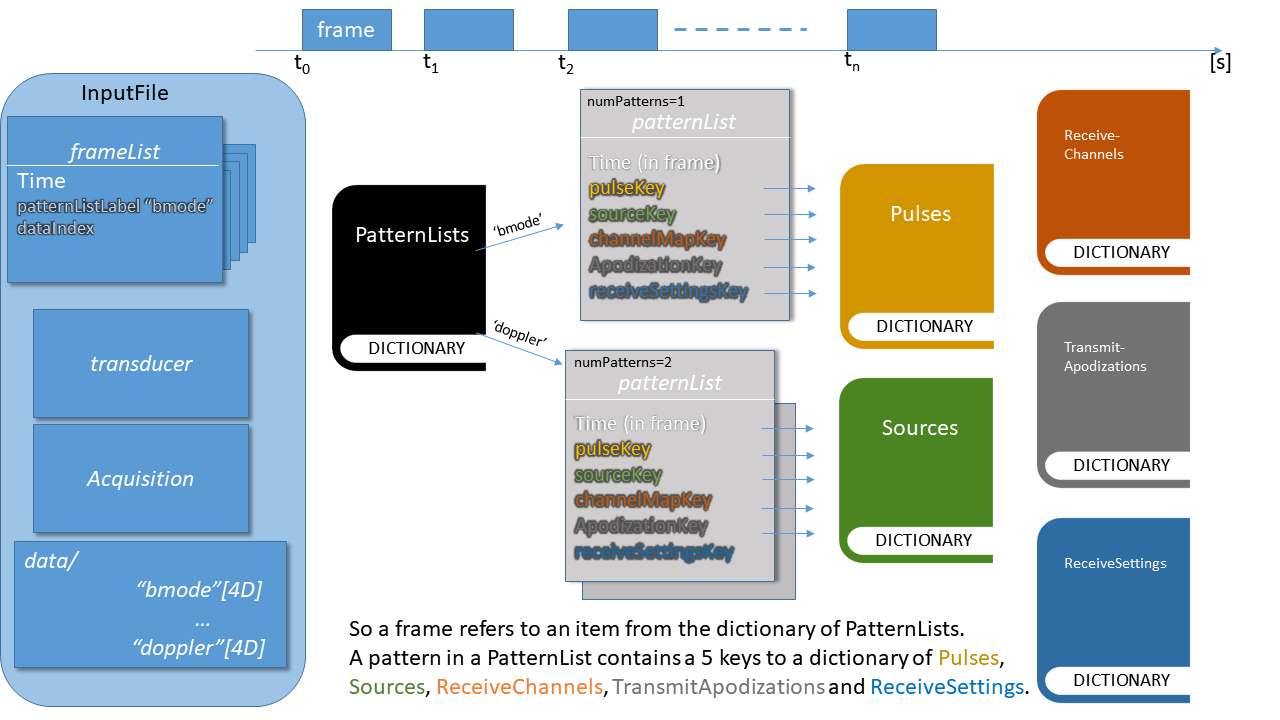
The header contains a IufFrameList where each IufFrame consists of a reference to a IufPatternList and a timestamp. The IufPatternList is a list of IufPattern. Which each contain references to 5 additional dictionaries: IufSource, IufReceiveSettings, IufReceiveChannelMap, IufTransmitApodization and IufPulse. Together these 5 objects from each dictionary describe the pattern. See the subsections blow.
In addition, an IufInputFile contains a transducer description IufTransducer and the acquistion method IufAcquisition.
The data is stored in a 4D block of floats for each IufPatternList with dimensions: numChannels x numSamplesPerLine x numPulses x numFrames. Note that this implies that these 4 dimension of each pattern in a patternList are constant. This is checked by the library when constructing a patternList using iufPatternListCreate() and iufPatternListSet().
IufSourceDict
The source dictionary contains a set of source types. A source does not have to contain a single point source, it can also contain multiple point sources, for example to approximate a line source or for creating transversal waves. The locations of the sources are either specified in 2D or 3D space and either parametric or non-paramteric, as such there are four options for an IufSourceType.
There is typically no need to define the generic IufSource Type, instead the API provides functions for each of the four types separately. For example, to define a source in 3D space that approximates a circlular arc (described by startPhi, deltaPhi) one would use: iuf3DParametricSourceCreate(). Please note that when one wants to compound individual insonifications from each point on the arc (i.e. fire individual pulses from each point source) then a pattern needs to be created for each of these insonifications and therefore also a source for each of these. In such a case each source then just contains a signle point. A IufSource is referenced by an IufPattern using a string as a key in a dictionary. Typicall an empty dictionary is constructed once with iufSourceDictCreate() and sources are added to the dictionary with iufSourceDictSet()
IufReceiveSettings
The receive settings are a collection of parameters that describe the acquisition settings closely relating to the Analog to Digital Conversion of the data. It consists of:
- float sampleFrequency: the data acqisition rate
- float startDelay: The time between the 1st sample and the timeStamp of the pattern
- int numSamplesPerLine: The number of samples acquired
- iutgc_t TGC: the Time Gain Control for these sampels: the tgc contains two arrays: time,gain describing or approximating the ADC amplifier function. An IufTGC is constructed using iufTGCCreate() and filled by setting the time/gain pairs at each index using iufTGCSet()
An IufPattern references an IufReceiveSettings with a string in a dictionary. Typically an empty disctionary is constructed once using iufReceiveSettingsDictCreate() and IufReceiveSettings are added to it with iufReceiveSettingsDictSet(). The receive settings can be created using iufReceiveSettingsCreate().
IufReceiveChannelMap
THe receiveChannelMap contains a mapping table describing how the transducer elements are fit to the numChannels receiving channels. Typically, not all elements can be captured simultaneously by an ultrasound system so numChannels is typically smaller then numElements. The IufReceiveChannelMap is numChannels long and contains the indices of the transducer elements. In case there is no channel mapping in place, a channel map needs to be created with a one-to-one mapping, i.e. an identity matrix of size numChannels==numElements. An IufReceiveChannelMap is constructed with iufReceiveChannelMapCreate() and set with iufReceiveChannelMapSetMap(). To add a IufReceiveChannelMap to a dictionary use iufReceiveChannelMapDictSet() once you have a dictionary created with iufReceiveChannelMapDictCreate()
IufPulse
The shape of the emitted pulse at each source point is described either parametrically or as an array of time-amplitude pairs. In case of an IufParametricPulse the pulse is considered to consists of a number of sinusoid periods defined by an amplitude, frequency and cycleCount or the pulse is IufNonParametricPulse it contains two float arrays of length numPulseValues named: pRawPulseAmplitudes and pRawPulseValues. The pulses are created with resp. iufParametricPulseCreate() and iufNonParametricPulseCreate() and both can be added to an IufPulseDict using iufPulseDictSet() once a pulse dictionary is created using iufPulseDictCreate().
IufTransmitApodization
The transmit Apodization describes the per-element gain of the transducer and is is allowed to change each IufPattern. The IufTransmitApodization is an array of floats of length numElements. I.e. there should be a gain for each transducer element. an IufTransmitApodization is created with iufTransmitApodizationCreate(), set with iufTransmitApodizationSetApodization() and added to a dictionary with iufTransmitApodizationDictSet()
iufCWCFile
iufBModeFile
iufColorDopplerFile
etc... /